
Volume 45 Issue Five May 2026
Last Trumpet Ministries ∙ PO Box 806 ∙ Beaver Dam, WI 53916
Phone: 920-887-2626 Internet: http://www.lasttrumpetministries.org
“For if the trumpet give an uncertain sound, who shall prepare himself to the battle?” I Cor. 14:8
Disruption
“In thee, O LORD, do I put my trust: let me never be put to confusion.” - Psalm 71:1
As we enter May 2026, the United States is still at war with Iran. The events surrounding this conflict have taken many twists and turns in recent weeks. Although the fighting itself has quieted, there remains great uncertainty about when, or if, it might resume. Nevertheless, the consequences of this war are being felt around the world and threaten to disrupt everyday life in unprecedented ways. In this edition of the Last Trumpet, we will look back at these recent events and consider their potential implications for the future.
A Close Call
As April began, the coalition between the United States and Israel was heavily involved in combat operations against Iran. From the start of the war, coalition forces have mostly imposed their will over Iranian territory without significant resistance. However, on April 3, 2026, an American F-15E fighter jet was shot down over Iranian territory. The two crew members onboard were forced to eject from the plane, leading to the dire possibility of American soldiers falling into the hands of the Iranian regime. For the first time since the war began, American forces would set foot on Iranian soil to conduct two daring rescue missions in a high-stakes race against time. (1)
The pilot was located and found within hours, but the whereabouts of the weapons systems officer remained a mystery. (2) To pinpoint his location, the U.S. military enlisted the help of the Central Intelligence Agency (CIA). The CIA used its secret technology to locate the missing soldier who had been stuck behind enemy lines for more than 24 hours. “This was the ultimate needle in a haystack, but in this case it was a brave American soul inside a mountain crevice, invisible but for CIA’s capabilities,” an unnamed U.S. official told Axios. (3)
The search was conducted with great urgency. Not only were the Americans looking for the soldier, but so too were the Iranians. “This brave warrior was behind enemy lines in the treacherous mountains of Iran, being hunted down by our enemies, who were getting closer and closer by the hour,” wrote American President Donald Trump. (4)
In an effort to find the American soldier before he could be rescued, Iran’s Islamic Revolutionary Guard Corps offered a reward of about $66,000 to any Iranian citizen who could locate him. (5) This is a tremendous amount of money for an Iranian citizen, and many were no doubt highly motivated to find the missing airman.
With the soldier safely recovered, Trump recounted some of the details of the rescue mission to Axios. He explained that the military aircraft had been hit by a shoulder-fired missile. “They got lucky,” Trump admitted. He then explained that American officials were worried at first that the soldier had already been captured by the Iranians because of an unusual final radio message. “God is good,” the airman said as he ejected from the aircraft. “What he said on the radio sounded like something a Muslim would say,” Trump opined. However, those who knew the soldier told officials the man was religious, and so they moved forward with a rescue mission involving two hundred soldiers. (6) Had Iran been successful in its endeavors to locate the airman, it could have changed the trajectory of the war. Capturing the soldier would have given the regime leverage in negotiations and could have easily resulted in the American being imprisoned, tortured, or killed. Thankfully, he was rescued before Iran got their hands on him. God is good, indeed.
How’s It Playing?
After the close call in Iran, something seemed to change in President Trump’s mindset. On April 5, 2026, the President posted a menacing message on Truth Social, threatening to blow up bridges and power plants in Iran if the regime did not reopen the Strait of Hormuz. “Tuesday will be Power Plant Day, and Bridge Day, all wrapped up in one, in Iran. There will be nothing like it!!! Open the (expletive) Strait, you crazy (expletive), or you'll be living in Hell - JUST WATCH! Praise be to Allah. President DONALD J. TRUMP.” (7) Clearly, the President’s patience was wearing thin.
Trump’s post on social media bewildered many people. The President’s aides soon began receiving phone calls from fellow Republicans and Christian leaders. They wanted to know why the President had used vulgar language, including the F-word, in a public post. They wanted to know why he said, “Praise be to Allah.” According to the Wall Street Journal, Trump later told an adviser that he came up with the idea to invoke Allah in an effort to “seem as unstable and insulting as possible, believing it could bring the Iranians to the table.” The President later asked an adviser, “How’s it playing?” (8)
Iran seemed unfazed by Trump’s social media threat, so the President took a step further on April 7, 2026, writing, “A whole civilization will die tonight, never to be brought back again. I don’t want that to happen, but it probably will.” (9) Still, the Iranians remained defiant, the Strait of Hormuz remained closed, and there was no deal to end the war in Iran. “More than 14 million Iranian people have declared their readiness to sacrifice their lives in the (self-sacrificing)campaign. I too have been, am, and will remain ready to give my life for Iran,” Iranian President Masoud Pezeshkian posted on X. (10) Iranian official Alireza Rahimi urged “all young people, athletes, artists, students, and university students and their professors” to form human chains around power plants in Iran. The Iranian military warned Trump that if he followed through on his threats, Iran would “deprive the U.S. and its allies of the region’s oil and gas for years.” (11)
As Trump’s April 7, 2026, 8 PM Eastern time deadline approached, (12) many wondered what would happen next. Would there be a ground invasion? Would the United States really attack Iranian infrastructure and demolish Iranian society? Shortly before the deadline was set to expire, Trump announced that Iran had agreed to a two-week ceasefire and would participate in negotiations to end the war. “Almost all of the various points of past contention have been agreed to between the United States and Iran, but a two week period will allow the Agreement to be finalized and consummated,” Trump wrote. (13)
A Fragile Ceasefire
With hostilities put on hold, the two sides assembled in Islamabad, Pakistan, on April 11, 2026. The American delegation was led by Vice President J.D. Vance, special envoy Steve Witkoff, and Donald Trump’s son-in-law Jared Kushner. The Iranian side included Foreign Minister Abbas Araghchi and the Iranian Speaker of Parliament, Mohammad Bagher Ghalibaf. Despite a marathon 21-hour session, no agreement was reached. “They have chosen not to accept our terms,” said Vice President Vance. “We leave here with a very simple proposal: a method of understanding that this is our final and best offer.” He then added a possibility with a glimmer of hope that Iran might reconsider, “We’ll see if the Iranians accept it.” (14)
Despite the widespread destruction caused by American and Israeli strikes in Iran and despite the threats from President Trump, Iran never moved away from its demands during the negotiations. According to Iranian foreign ministry spokesman Esmaeil Baqaei, topics of discussion included “various dimensions of the main negotiation topics, including the Strait of Hormuz, the nuclear issue, war reparations, lifting of sanctions, and the complete end to the war against Iran and in the region.” He also added that successful negotiations would require “acceptance of Iran’s legitimate rights and interests.” (15) Iran is especially keen to retain control of the Strait of Hormuz as the vital waterway would prove to be a significant source of income for the regime.
Shortly after the peace talks failed to yield an agreement, President Trump ordered the U.S. Navy to conduct a blockade of Iranian ports in the Strait of Hormuz. “So, there you have it, the meeting went well, most points were agreed to, but the only point that really mattered, NUCLEAR, was not. Effective immediately, the United States Navy, the Finest in the World, will begin the process of BLOCKADING any and all Ships trying to enter, or leave, the Strait of Hormuz,” Trump wrote on Truth Social. (16) Prior to the blockade, Iran heavily restricted traffic in the strait, only allowing ships with its explicit consent to transit the waterway unmolested. Consequently, Iran was earning significant profits from oil sales. Trump’s blockade, which is still in place as of this writing, is aimed at ending Iran’s control of the crucial route through which 20 percent of the world’s oil supply passes under normal circumstances. As of April 24, 2026, U.S. Defense Secretary Pete Hegseth has claimed that the U.S. Navy has turned back at least thirty-four vessels in the Strait of Hormuz. (17) Thus, both the United States and Iran are imposing their will in the strait. As a result, traffic has slowed to a trickle, calling into question how the disruption will impact the world in the months to come.
As for the ceasefire, two weeks passed with no resolution. However, the President announced the indefinite extension of the truce on April 21. For the time being, the blockade would remain in place, and if no progress was made towards a deal, Trump threatened more military action against Iran. “Well, I expect to be bombing, because I think that's a better attitude to go in with. But we're ready to go. I mean, the military is raring to go,” Trump insisted. (18)
A Severe Shock
On April 28, 2026, President Trump met with executives from oil companies to discuss the deadlock in the Strait of Hormuz. “They discussed the steps President Trump has taken to alleviate global oil markets and steps we could take to continue the current blockade for months if needed and minimize impact on American consumers,” a White House official said. (19) A day later, CNBC reported that the average cost of gasoline had risen to a new high for the year, reaching an average cost of $4.23 per gallon nationwide. (20)
While Americans are paying more at the pump, the impact of the war is being felt globally. In mid-April, the International Energy Agency (IEA) said the war in Iran had caused the “most severe oil supply shock in history.” The organization’s executive director, Faithe Birol, was quoted as saying, “The conflict in the Middle East is having significant impacts on global oil and gas markets with major implications for energy security, energy affordability and the global economy.” (21) However, the disruption goes beyond oil and gasoline.
According to the Jerusalem Post, the World Bank predicts that energy prices will surge by 24 percent worldwide in 2026. The organization also warns that the cost of urea, a vital component in fertilizer production, will rise by 60 percent. As such, fertilizer costs are expected to increase by 31 percent, making crop production significantly more expensive. “The war is hitting the global economy in cumulative waves: first through higher energy prices, then higher food prices, and finally, higher inflation, which will push up interest rates and make debt even more expensive,” said Indermit Gill, Chief Economist at World Bank Group. (22)
Economists say the global economy might avoid a recession if the war in Iran ends soon and the Strait of Hormuz reopens. However, if the Strait remains closed for months, which is now being presented as a possibility, an economic downturn may be difficult to avoid. “In my view, a full-on global recession is more likely than not if the Strait remains closed for, say, another three months, which seems all too possible,” said Paul Krugman, an economics professor at the City University of New York Graduate Center. (23) A blog post from Oxford Economics predicts that oil prices will jump to $190 per barrel in August if the impasse in the Strait of Hormuz persists for six months. (24) According to Time Magazine, if oil reaches $200 a barrel, it will likely push gasoline prices to $7 per gallon in the United States. (25) Ominously, the average price per gallon surpassed $6 in California on April 30, 2026. (26)
While consumers are most likely to notice the higher price of gasoline, the rising cost of diesel fuel is also an enormous concern. Much of the world’s diesel supply is exported from the Middle East, but the war has stemmed the flow of this vital resource. The cost of diesel has risen by more than 45 percent since hostilities began in Iran. (27) The ramifications of this increase cannot be understated. Diesel is the most common type of fuel used by both the trucking industry and by farmers to power heavy agricultural equipment. Thus, if diesel is significantly more expensive than before, it follows that everything transported by truck and everything planted and harvested by farmers will be more expensive, too. “It’s diesel that really runs the economy, and kind of runs the world,” said Joe DeLaura, a global energy strategist at Rabobank. (28)
The Strait of Hormuz will likely reopen someday, and the sooner the better. However, even when this happens, traffic will not return to normal immediately. “The issue is not solved...[until] all the ships have left the Strait of Hormuz, because there are hundreds of thousands of containers at ports in India, Oman, and Pakistan, which need to be transported into the Persian Gulf,” said Nils Haupt of the shipping firm Hapag-Lloyd. He then added, “It will take weeks, if not months, to reintroduce the original shipping schedules that we had before the start of the war.” (29) All signs point toward a costly summer. As we navigate these difficult times, it is crucial that we remember that our God is able to help and strengthen us in times of trouble. Psalm 46:1 declares, “God is our refuge and strength, a very present help in trouble.” Nahum 1:7 also reassures us, “The LORD is good, a strong hold in the day of trouble; and he knoweth them that trust in him.”
A Controversial Image
A week after President Trump offered his praise to Allah on Truth Social, the leader of the free world again took to his favorite social media network and caused another uproar when he posted an image generated by artificial intelligence that appeared to depict him as Jesus Christ. The image featured Trump in a long white robe, hovering over a man in a bed who appeared to be suffering from an infirmity. Trump’s hand glowed with an orb of light, suggesting a healing was taking place. The image calls to mind the type of healings performed by Christ and often recorded in the Gospels. Hopeful onlookers watched as Trump appeared to heal a sick man. The image included patriotic symbols such as an American flag, an eagle, fireworks, and the Statue of Liberty. It is unknown what the President was thinking when he decided to post this image on social media, but the backlash was swift and emphatic. “I don’t know if the President thought he was being funny or if he is under the influence of some substance or what possible explanation he could have for this OUTRAGEOUS blasphemy. But he needs to take this down immediately and ask for forgiveness from the American people and then from God,” wrote Megan Basham, a well-known conservative Christian writer. An administration official, speaking on the condition of anonymity, noted that Trump’s biggest supporters often cast him in a messianic light, but also said it was not a good look for the President to do so himself. “Other people at these Trump rallies do it for him, but when you do it yourself, … it’s sacrilegious at best.” (30)
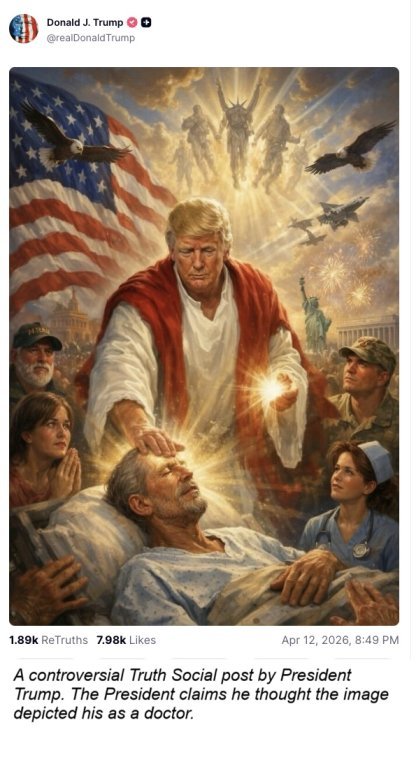
The President did eventually remove the image. Later, when asked about it, he claimed he thought the image portrayed him as a doctor. “I thought it was me as a doctor,” Trump insisted. He then added, “I make people better.” I must confess, Trump, as depicted in the image, does not look like any doctor I have ever seen. It is also not typical for civilians to be watching with cupped hands as a doctor treats a patient. The President would do well to exercise more caution and discernment regarding what he posts on social media. The Apostle Paul warns in Galatians 6:7, “Be not deceived; God is not mocked: for whatsoever a man soweth, that shall he also reap.”
A Party Interrupted
Political violence again reared its ugly head in the United States on April 25, 2026, when an armed man attempted to breach security at the Washington Hilton Hotel where the White House Correspondence Dinner was underway. The would-be assassin was quickly apprehended by law enforcement; however, one Secret Service agent was shot. Thankfully, his bulletproof vest prevented any serious injuries. Speaking of the shooter, Trump said, “My impression is that he was a lone wolf, a whack job.” (31) The suspect was later identified as 31-year-old Cole Tomas Allen, a tutor from Torrance, California. (32)
In a strange twist, White House Press Secretary Karoline Leavitt made a peculiar remark hours before the event was set to begin. “It’ll be funny. It’ll be entertaining. There will be some shots fired tonight in the room. Everyone should tune in, it’s going to be really great.” (33) Her poorly-timed comment helped fuel rumors that the assassination attempt was staged. Clearly, there is a lot of mistrust in American society today. This phenomenon was noted by Katie Sanders, the editor-in-chief of Politifact, who said, “We’re in an information environment where people are just not believing anything they see because they’ve become so exhausted by the steady tide of information everyone is sharing that later turns out to be not true.” (34) Thankfully, even amid uncertainty and confusion, we can always find the truth in God’s Word. While humans often struggle to understand what is happening, God is never confused. For as it tells us in Psalm 147:5, “Great is our Lord, and of great power: his understanding is infinite.” It is this God of infinite wisdom and understanding who promised that His Spirit would guide us as we navigate this world. Jesus tells us in John 14:26, “But the Comforter, which is the Holy Ghost, whom the Father will send in my name, he shall teach you all things, and bring all things to your remembrance, whatsoever I have said unto you.” If you have not yet repented of your sins and dedicated your life to God, I urge you to do so now.
Thank you for your kind support of this ministry. If you have any prayer needs, we invite you to send us your requests. Each request is always given individual attention, and we know that God hears the prayers of His people. The grace of our Lord Jesus Christ be with you all. Amen.
Samuel David Meyer
This newsletter is made possible by the kind donations of our supporters. If you would like to help us, you may send your contribution to our postal address or donate online at http://lasttrumpetnewsletter.org/donate.
References
01. Axios, April 3, 2026, By Barak Ravid, axios.com.
02. Axios, April 4, 2026, By Barak Ravid, axios.com.
03. Ibid.
04. Ibid.
05. BBC News, April 4, 2026, By Simi Jolaoso, bbc.com.
06. Axios, April 5, 2026, By Barak Ravid and Dave Lawler, axios.com.
07. The Wall Street Journal, April 18, 2026, By Josh Dawsey and Annie Linskey, wsj.com.
08. Ibid.
09. Ibid.
10. Associated Press, April 7, 2026, By Jon Gambrell, apnews.com.
11. Associated Press, April 7, 2026, By Bassem Mroue, Jon Gambrell, Mike Corder, and Samy Magdy, apnews.com.
12. USA Today, April 7, 2026, By Kathryn Palmer, usatoday.com.
13. Associated Press, April 7, 2026, By Bassem Mroue, Jon Gambrell, and Samy Magdy, apnews.com.
14. The New York Times, April 14, 2026, By Tyler Pager, Farnaz Fassihi, Elian Peltier, and Aaron Boxerman, nytimes.com.
15. Ibid.
16. Fox News, April 12, 2026, By Taylor Penley, foxnews.com.
17. The New York Times, April 24, 2026, By Pranav Baskar, nytimes.com.
18. CBS News, April 21, 2026, By Kathryn Watson, cbsnews.com.
19. Reuters, April 29, 2026, By Timothy Gardner, reuters.com.
20. NBC News, April 29, 2026, By Rob Wile, nbcnews.com.
21. ABC News, April 14, 2026, By Max Zahn, abcnews.com.
22. The Jerusalem Post, April 29, 2026, By Danielle Greyman-Kennard, jpost.com.
23. ABC News, April 24, 2026, By Max Zahn, abcnews.com.
24. Ibid.
25. Time Magazine, March 30, 2026, By Chad de Guzman and Rebecca Schneid, time.com.
26. Bloomberg, April 3, 2026, By Will Kubzansky, bloomberg.com.
27. The New York Times, April 23, 2026, By Emmett Lindner, nytimes.com.
28. Ibid.
29. CNBC, April 9, 2026, By Anniek Bao and Joseph Wilkins, cnbc.com.
30. The Washington Post, April 13, 2026, By Natalie Allison, washingtonpost.com.
31. Fox News, April 26, 2026, By Morgan Phillips, foxnews.com.
32. The Guardian, April 29, 2026, By Cate Brown, theguardian.com.
33. Yahoo News, April 25, 2026, By Isley Zegas, news.yahoo.com.
34. The Hill, April 27, 2026, By Dominick Mastrangelo, thehill.com.
1